

eMCP
eMCP is MCP for devices, on rmcp, the official Rust MCP SDK: a loopback Streamable HTTP server for your own tools, a blocking client for any server, OAuth with a vault for its credentials, the local hub that puts several servers behind one endpoint, and code mode. Apache-2.0.
Status
Section titled “Status”The latest release is emcp-v0.2.0.
| Part | Where | State |
|---|---|---|
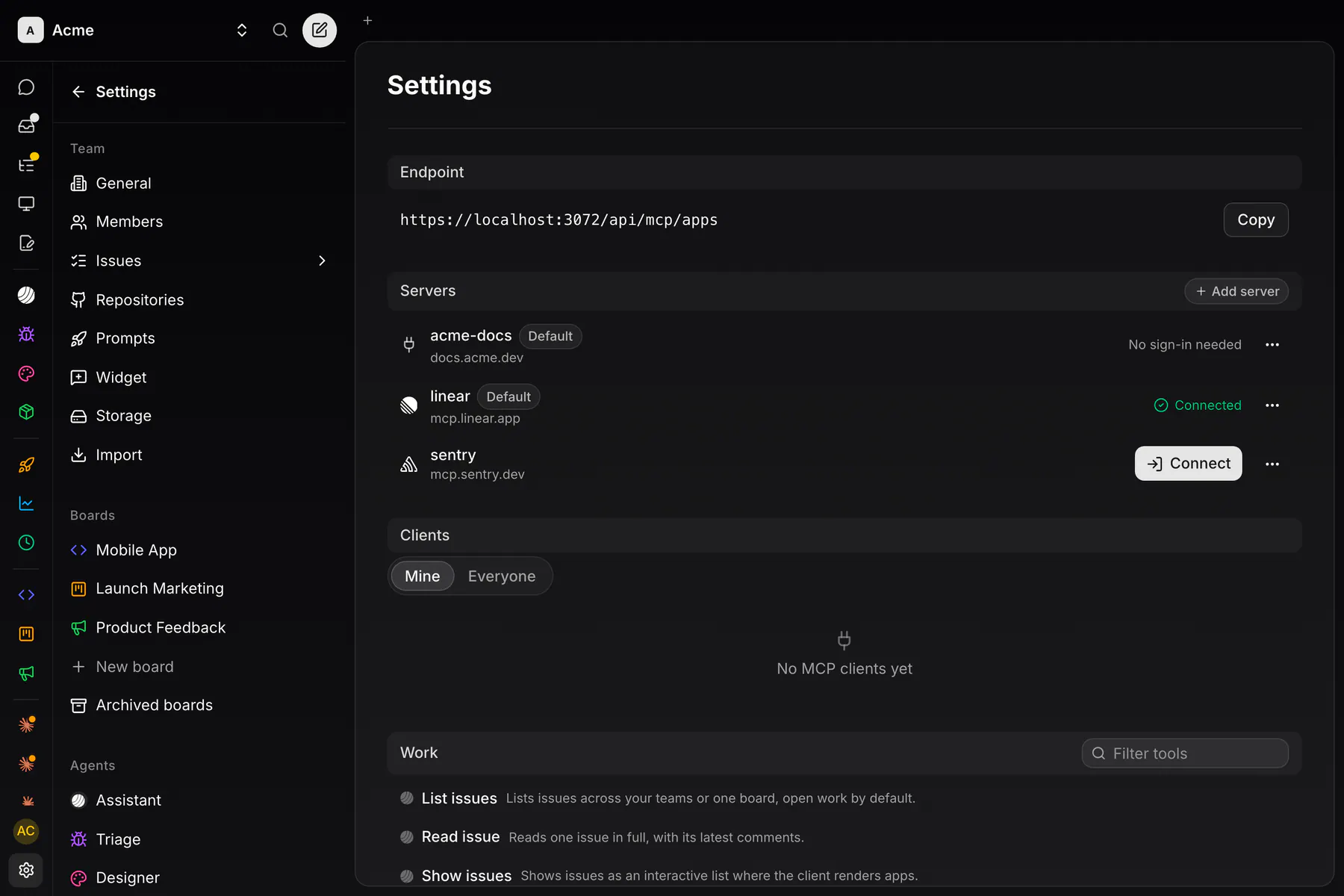
| Server and client | Code mode, ePilot and the MCP calls of the desktop app and the CLI daemon | in the app |
| App tool broker | An app’s exposes as MCP tools at /api/mcp/apps, with consent, access and audit |
in the app |
| The contract | The fixtures in packages/emcp, replayed in Rust and TypeScript |
built |
| The library | emcp, a git dependency |
0.2.0 |
On the server, the same contract runs the broker for app MCP tools.
Serve tools
Section titled “Serve tools”Implement ToolProvider and serve it. The server listens on 127.0.0.1, answers plain JSON, and admits each run with its own bearer token: an unknown or revoked token is refused before any tool runs. A refusal the agent should read is content in the result.
Call a server
Section titled “Call a server”Client::connect does the handshake against any Streamable HTTP server with the headers you resolved. Header values are never logged and never appear in an error.
OAuth and the vault
Section titled “OAuth and the vault”For a server behind OAuth, emcp::oauth discovers the authorization server, registers the client, runs PKCE and refreshes expired tokens. The credentials live in a Vault you implement: the OS keychain on a device, a server-backed store for a member’s connection. SealedVault encrypts every value with the vault format before it reaches your store; MemoryVault is for tests.
The local hub
Section titled “The local hub”One loopback endpoint over several MCP servers. Mount upstreams and in-process providers under a name, admit each run with a grant (read or write per server) and one token. The run lists <server>__<tool> for the tools its grant covers, and every call becomes one audit row.
Code mode
Section titled “Code mode”With the codemode feature, exec and describe on one endpoint: a script the agent writes calls the run’s other MCP servers as await tools.<server>.<tool>(args), in parallel, and only its output reaches the model.
The contract
Section titled “The contract”emcp::contract holds the rules an app tool broker follows, the same on the server and on a device. Each module mirrors one fixture in packages/emcp and replays every case of it.
| Module | What |
|---|---|
exposes |
An app’s MCP tools as declarative bindings: validation, input resolution, naming and collisions, provenance. |
access |
Who sees and calls which app tool: the member × app policy (none, read or write) and what revoking it ends. |
audit |
The audit row of every call: canonical JSON, the arguments hash, the status rule, 90 days of retention. |
vault |
Encryption at rest for every secret: the ev1 format, AES-256-GCM, bound to its row and key. |
upstream |
One member’s connection to one upstream server: its states, transitions and what is callable. |
hub |
The local hub: server names, a run’s tool list under its grant, routing, the audit row. |
actions |
Which exponential.<noun>.<op> actions exist, which are destructive or owner-only. |